

Introduction
The Acura MDX arrived in 2001 as Acura’s first three-row luxury SUV, and it has been in production ever since. It was the first SUV Acura built on a car-based platform, and it quickly became the brand’s best-selling model, staying in that role through four generations. From the start the MDX was built around a simple idea: a family SUV that drives like a sedan, with standard all-wheel drive and a V6 engine in every generation. Like every Acura, the MDX depends on the correct wheels for more than looks. The right fitment affects handling, braking, ride comfort, and safety, because the wrong wheels can add vibration, rub the bodywork, or upset the all-wheel-drive system.
This guide covers the wheel fitment of the Acura MDX generation by generation, from the first YD1 of 2001 to the current YD4. For each generation you will find the bolt pattern, hub bore, offset range, and wheel size recommendations, both factory and aftermarket. The MDX has one quirk that makes this guide especially important: its bolt pattern has changed three times, so a wheel from one generation will often not bolt onto another, even though the hub bore has never changed.
The bolt pattern story is the thread that runs through this guide. The first generation used 5×114.3mm, the second switched to 5x120mm, the early third generation went back to 5×114.3mm, and the 2017 facelift returned to 5x120mm, which the current fourth generation keeps. The 64.1 mm hub bore is the one constant across all four generations. This guide will help you match the right wheels to your exact model year, so you can avoid the most common and expensive fitment mistakes.
Whether you are replacing a damaged factory wheel or choosing aftermarket wheels for a sportier look, this guide will be your reliable source for Acura MDX wheel fitment. Let us now address the particular requirements of the car, beginning with its first generation.
First Generation (YD1: 2001–2006)
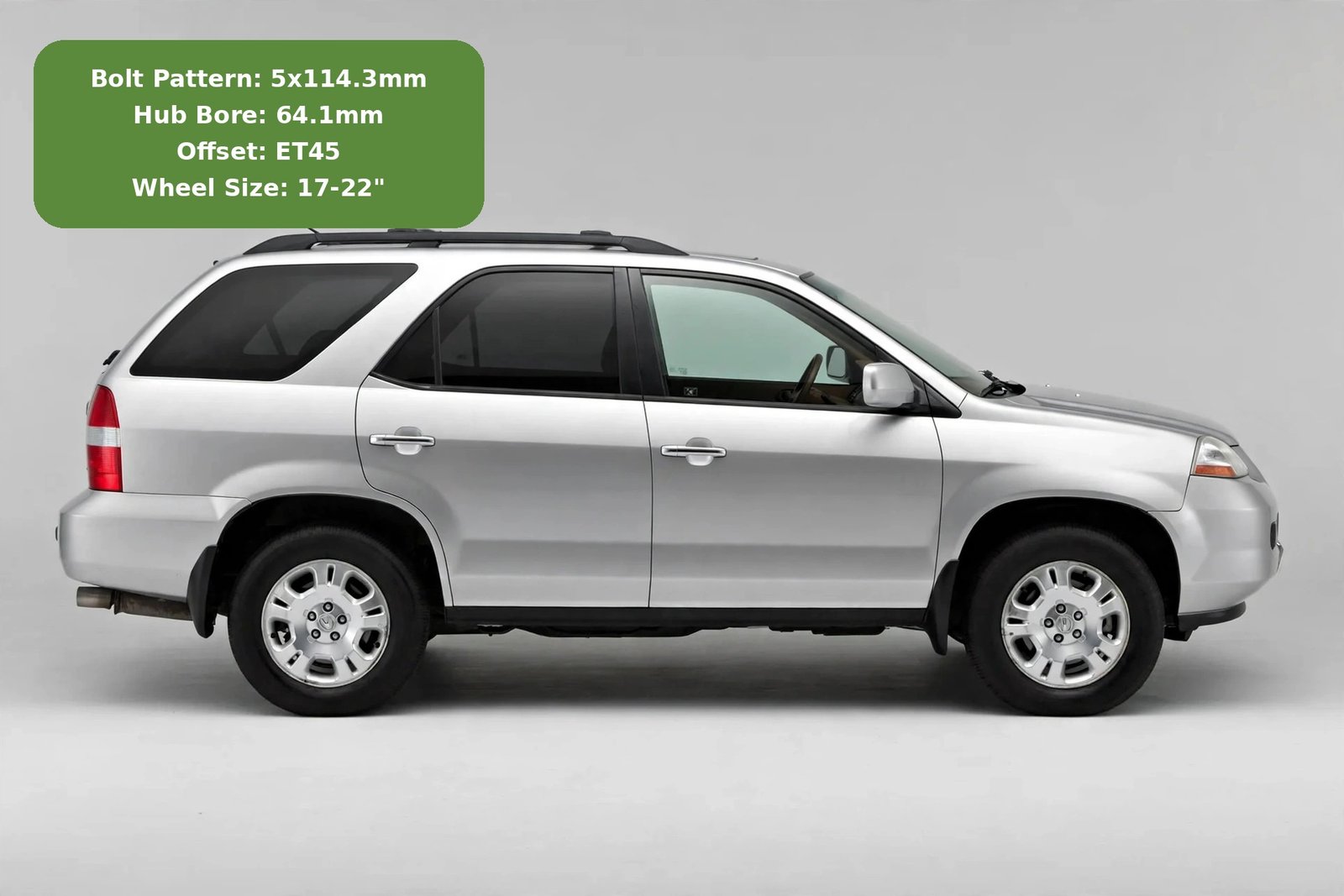
Made from 2001 to 2006, the first-generation MDX was Acura’s debut in the three-row luxury SUV class, powered by a 3.5-litre V6 making 240 hp in early cars and 253 to 265 hp in later ones, with standard all-wheel drive. Stock wheel size is 17×6.5 inches with an offset of ET45. The MDX used a 5×114.3mm bolt pattern, the Honda and Acura standard shared with the Pilot and many other models. Measuring 64.1 mm, its hub bore guaranteed fit for a wide range of aftermarket wheels meant for Honda and Acura cars. M12x1.5 was the lug nut thread size, tightened to 80 lb-ft (108 Nm). The factory tire size is 235/65 R17, and the recommended cold tire pressure is 32 psi. An 18-inch fitment is also recorded for this generation, a 7Jx18 wheel at ET45 with a 235/60 R18 tire. Aftermarket wheels from 17 inches to 22 inches in diameter and 6 to 8.5 inches wide are listed for this generation. Stated configurations should, however, keep a close rolling diameter to prevent interfering with the ABS and traction control systems.
| Model | Bolt Pattern | Hub Bore | Offset | OEM Wheel | Aftermarket Wheel |
|---|---|---|---|---|---|
| 2001 Acura MDX | 5×114.3mm | 64.1mm | ET45 | 17×6.5 | 17″ to 22″ |
| 2002 Acura MDX | 5×114.3mm | 64.1mm | ET45 | 17×6.5 | 17″ to 22″ |
| 2003 Acura MDX | 5×114.3mm | 64.1mm | ET45 | 17×6.5 | 17″ to 22″ |
| 2004 Acura MDX | 5×114.3mm | 64.1mm | ET45 | 17×6.5 | 17″ to 22″ |
| 2005 Acura MDX | 5×114.3mm | 64.1mm | ET45 | 17×6.5 | 17″ to 22″ |
| 2006 Acura MDX | 5×114.3mm | 64.1mm | ET45 | 17×6.5 | 17″ to 22″ |
On aftermarket wheels, owners of the first-generation MDX often step up to 18- or 19-inch wheels for a sharper look, while the 20- and 22-inch options suit show builds more than daily driving, since the taller sidewall of the stock 17-inch tire is part of what makes this generation ride so comfortably. Always confirm clearance, particularly if you are switching to bigger brakes, and match all four tires by make, type, and size, since the all-wheel-drive system is sensitive to mismatched rolling diameters.
Special Considerations
Although the first-generation MDX allows several wheel choices, make sure your selected wheels and tires fit the factory suspension. This generation is now over twenty years old, so check the condition of the wheel hubs and lug studs before fitting new wheels, and replace any corroded hardware. Lowering springs or coilovers could call for changes to stop rubbing. After any wheel modification, alignments should also be reviewed to preserve the best handling. Check the tire placard on the driver’s-door jamb for your exact car, because tire pressure can differ by market and load.
Second Generation (YD2: 2007–2013)
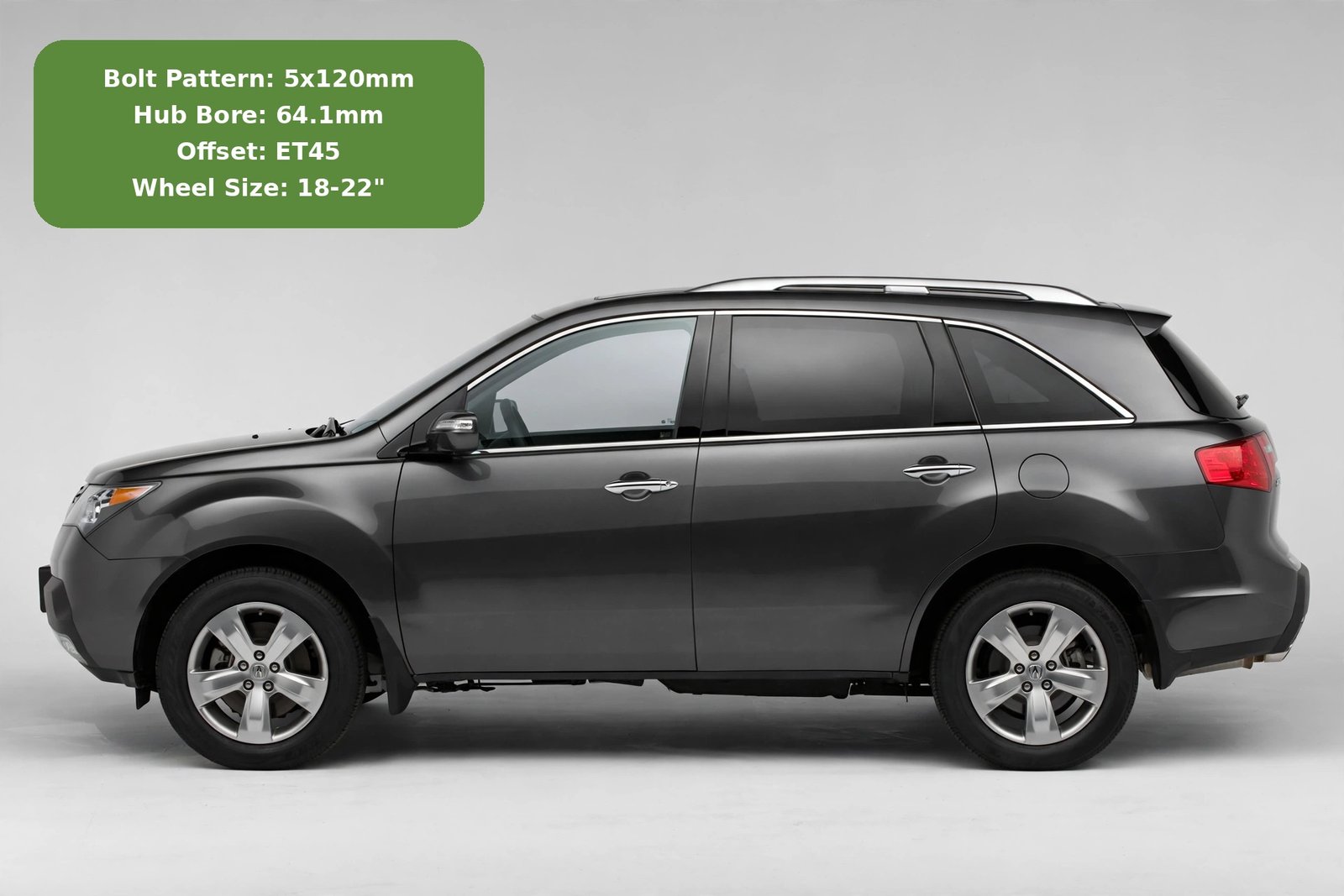
Made from 2007 to 2013, the second-generation MDX swapped the 3.5-litre V6 for a 3.7-litre V6 making 300 hp, with a sharper chassis, Super Handling All-Wheel Drive, and a much bolder look. Stock wheel size is 18×8 inches with an offset of ET45, and the Advance trim came with 19×8.5-inch wheels, also at ET45. This generation changed the bolt pattern to 5x120mm, so first-generation wheels will not bolt onto it. The hub bore stayed 64.1 mm, and the lug nut thread changed to M14x1.5, tightened to 93.6 lb-ft (127 Nm). The factory tire sizes are 255/55 R18 on the 18-inch wheel and 255/50 R19 on the 19-inch wheel. Aftermarket wheels from 18 inches to 22 inches in diameter and 8 to 9 inches wide are listed for this generation, with offsets from ET35 to ET45. Stated configurations should, however, keep a close rolling diameter to prevent interfering with the ABS and traction control systems.
| Model | Bolt Pattern | Hub Bore | Offset | OEM Wheel | Aftermarket Wheel |
|---|---|---|---|---|---|
| 2007 Acura MDX | 5x120mm | 64.1mm | ET45 | 18×8 | 18″ to 22″ |
| 2008 Acura MDX | 5x120mm | 64.1mm | ET45 | 18×8 | 18″ to 22″ |
| 2009 Acura MDX | 5x120mm | 64.1mm | ET45 | 18×8 | 18″ to 22″ |
| 2010 Acura MDX | 5x120mm | 64.1mm | ET45 | 18×8 | 18″ to 22″ |
| 2011 Acura MDX | 5x120mm | 64.1mm | ET45 | 18×8 | 18″ to 22″ |
| 2012 Acura MDX | 5x120mm | 64.1mm | ET45 | 18×8 | 18″ to 22″ |
| 2013 Acura MDX | 5x120mm | 64.1mm | ET45 | 18×8 | 18″ to 22″ |
On aftermarket wheels, the popular upgrade for this generation is a 20-inch wheel with a 275/40 R20 tire, which fills the arches without changing the rolling diameter much, while the 19-inch Advance setup remains the sweet spot for ride comfort. The 2010 facelift brought revised styling but no change to the wheel fitment, so the same wheels fit every year from 2007 to 2013. Always confirm brake clearance, particularly if you are switching to bigger brakes, and match all four tires by make, type, and size, since the SH-AWD system is sensitive to mismatched rolling diameters.
Special Considerations
Although the second-generation MDX allows several wheel choices, make sure your selected wheels and tires fit the factory suspension. The switch to the 5x120mm bolt pattern means wheels from the first generation and from the 2014–2016 third generation will not fit, so always check the pattern stamped on the wheel before buying. Lowering springs or coilovers could call for changes to stop rubbing, especially with wider 9-inch wheels. After any wheel modification, alignments should also be reviewed to preserve the best handling. Check the tire placard on the driver’s-door jamb for your exact car, because tire pressure can differ by market and load.
Third Generation (YD3: 2014–2020)
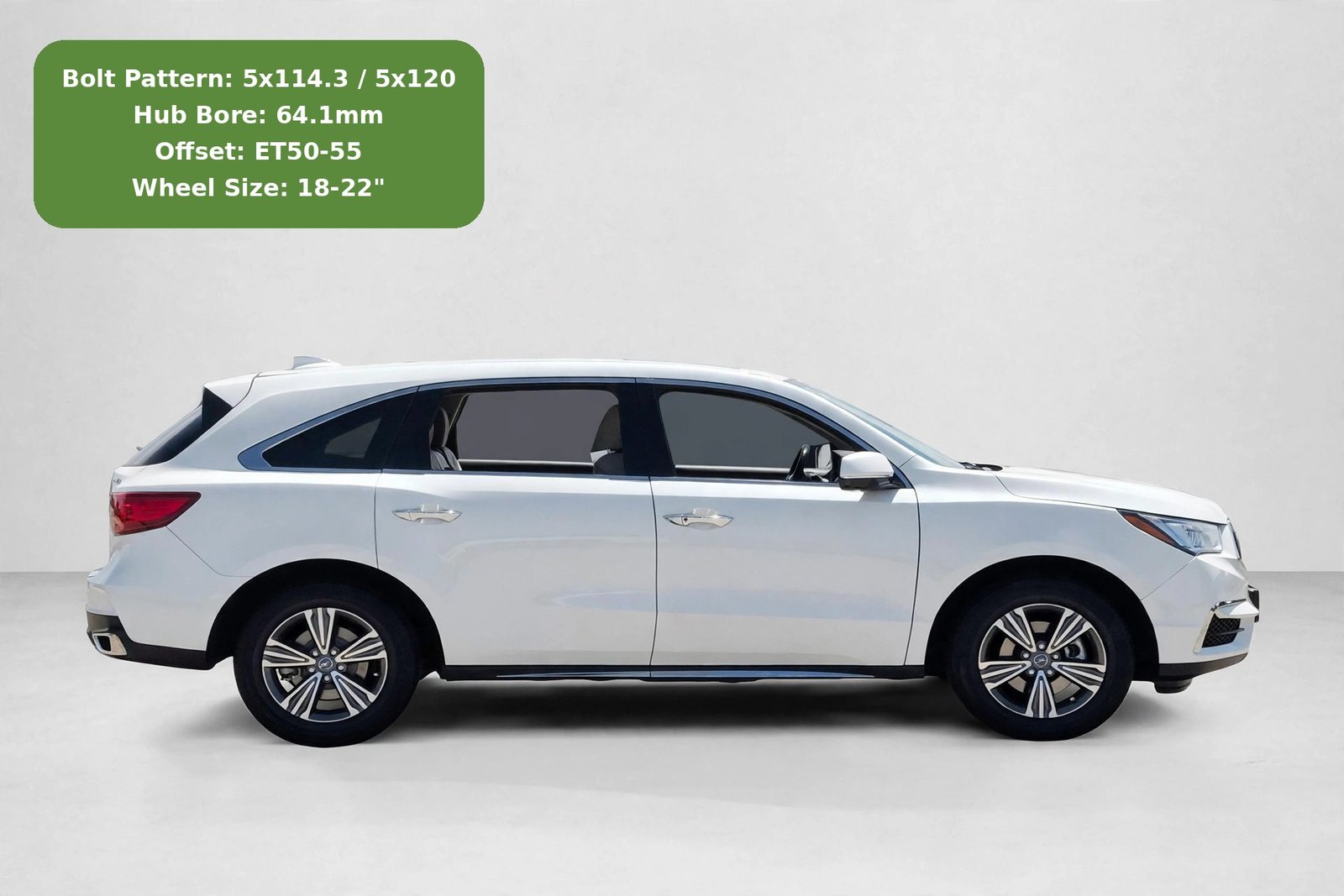
Made from 2014 to 2020, the third-generation MDX returned to a 3.5-litre V6 making 290 hp, with a lighter body, a quieter cabin, and a hybrid version joining the range in 2017. This is the generation where you must check the model year before ordering wheels, because the bolt pattern changed in the middle of its life. Cars built from 2014 to 2016 use a 5×114.3mm bolt pattern with M12x1.5 lug nuts, while the 2017 facelift switched back to a 5x120mm bolt pattern with M14x1.5 lug nuts. The hub bore stayed 64.1 mm on every car. Stock wheel size is 18×8 inches with an offset of ET55 on the base car, with a 19×8-inch wheel at ET55 on uplevel trims. The facelift added a 20×8-inch wheel at ET55 and a 20×8.5-inch wheel at ET50 on Advance, A-Spec, and Hybrid models, while the Hybrid could also be had with a 21×9-inch wheel at ET50. The factory tire sizes are 245/60 R18 and 245/55 R19 on the early cars, and 245/60 R18, 245/50 R20, 265/45 R20, and 275/40 R21 on the facelift cars. Aftermarket wheels from 18 inches to 22 inches in diameter and 8 to 9 inches wide are listed for this generation. Stated configurations should, however, keep a close rolling diameter to prevent interfering with the ABS and traction control systems.
| Model | Bolt Pattern | Hub Bore | Offset | OEM Wheel | Aftermarket Wheel |
|---|---|---|---|---|---|
| 2014 Acura MDX | 5×114.3mm | 64.1mm | ET55 | 18×8 | 18″ to 22″ |
| 2015 Acura MDX | 5×114.3mm | 64.1mm | ET55 | 18×8 | 18″ to 22″ |
| 2016 Acura MDX | 5×114.3mm | 64.1mm | ET55 | 18×8 | 18″ to 22″ |
| 2017 Acura MDX | 5x120mm | 64.1mm | ET50–55 | 18×8 | 18″ to 22″ |
| 2018 Acura MDX | 5x120mm | 64.1mm | ET50–55 | 18×8 | 18″ to 22″ |
| 2019 Acura MDX | 5x120mm | 64.1mm | ET50–55 | 18×8 | 18″ to 22″ |
| 2020 Acura MDX | 5x120mm | 64.1mm | ET50–55 | 18×8 | 18″ to 22″ |
On aftermarket wheels, the 20-inch setup with a 245/50 R20 or 265/45 R20 tire is the most popular upgrade across this generation, and it fits both the early and the facelift cars as long as the bolt pattern matches the year. The Hybrid’s 21-inch wheels are a factory option, not an aftermarket size, and they need the wider ET50 offset to clear the bodywork. Never try to fit a 2015 wheel on a 2018 car or the other way round: the patterns are different, and no spacer or adapter makes that a safe daily-driving setup. Always confirm brake clearance, particularly on Hybrid models, and match all four tires by make, type, and size, since the SH-AWD system is sensitive to mismatched rolling diameters.
Special Considerations
Although the third-generation MDX allows several wheel choices, make sure your selected wheels and tires fit the factory suspension. The mid-generation bolt pattern change is the single biggest trap in MDX fitment: a wheel that fits a 2016 car will not fit a 2017 car, even though the two cars look almost identical. The facelift also brought a standard tire pressure monitoring system, so any new wheel needs a compatible TPMS sensor fitted and relearned. Lowering springs or coilovers could call for changes to stop rubbing, especially with wider 9-inch wheels. After any wheel modification, alignments should also be reviewed to preserve the best handling. Check the tire placard on the driver’s-door jamb for your exact car, because tire pressure can differ by market and load.
Fourth Generation (YD4: 2022–Present)
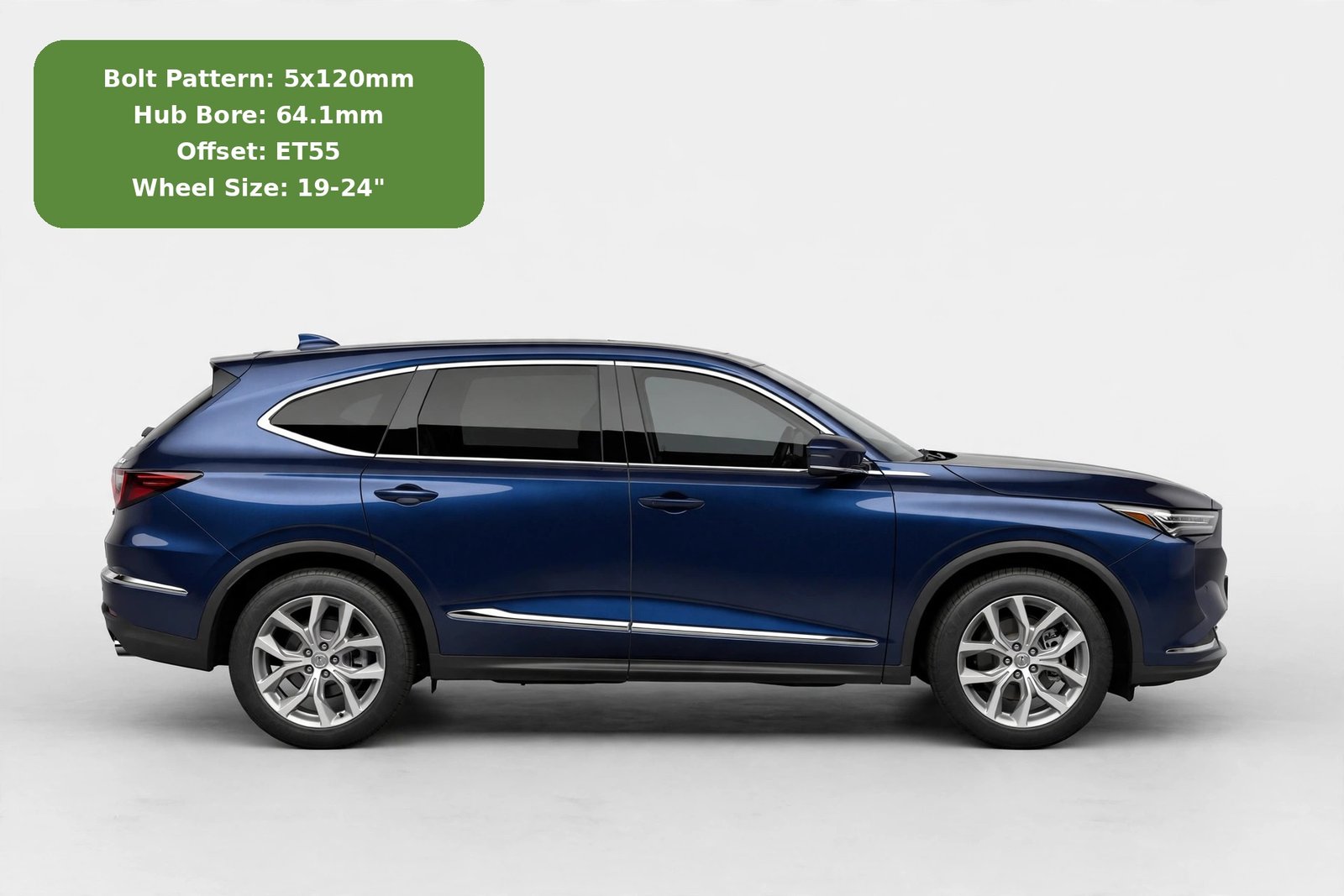
Made from 2022 to the present, the fourth-generation MDX went on sale in early 2021 as a 2022 model, which is why some fitment databases list this generation from 2021. It rides on a new platform with a double-wishbone front suspension, a 3.5-litre V6 making 290 hp, and a Type S model with a 3.0-litre turbo V6 making 355 hp. Stock wheel size is 19×8.5 inches with an offset of ET55, and uplevel trims came with 20×9-inch wheels, also at ET55. The Type S rides on 21×9.5-inch wheels at ET55. This generation keeps the 5x120mm bolt pattern and the 64.1 mm hub bore from the facelifted third generation, with M14x1.5 lug nuts. The factory tire sizes are 255/55 R19 on the 19-inch wheel, 255/50 R20 on the 20-inch wheel, and 275/40 R21 on the Type S. Aftermarket wheels from 19 inches to 24 inches in diameter and 8.5 to 9.5 inches wide are listed for this generation, with offsets from ET45 to ET55 around the factory ET55 figure. Stated configurations should, however, keep a close rolling diameter to prevent interfering with the ABS and traction control systems.
| Model | Bolt Pattern | Hub Bore | Offset | OEM Wheel | Aftermarket Wheel |
|---|---|---|---|---|---|
| 2022 Acura MDX | 5x120mm | 64.1mm | ET55 | 19×8.5 | 19″ to 24″ |
| 2023 Acura MDX | 5x120mm | 64.1mm | ET55 | 19×8.5 | 19″ to 24″ |
| 2024 Acura MDX | 5x120mm | 64.1mm | ET55 | 19×8.5 | 19″ to 24″ |
| 2025 Acura MDX | 5x120mm | 64.1mm | ET55 | 19×8.5 | 19″ to 24″ |
| 2026 Acura MDX | 5x120mm | 64.1mm | ET55 | 19×8.5 | 19″ to 24″ |
On aftermarket wheels, the Type S is the car to watch: it adds large front Brembo brake calipers, so not every 19- or 20-inch wheel that fits a base MDX will clear the Type S brakes, and wheel-face clearance must be confirmed with the seller before ordering. For the standard MDX, a 20- or 21-inch wheel with the matching factory tire size is a straightforward upgrade, while 22- to 24-inch wheels are available but trade ride comfort for looks. Always confirm brake clearance, particularly on Type S models, and match all four tires by make, type, and size, since the SH-AWD system is sensitive to mismatched rolling diameters.
Special Considerations
Although the fourth-generation MDX allows several wheel choices, make sure your selected wheels and tires fit the factory suspension. The double-wishbone front suspension gives this generation more precise handling than its predecessors, but it also means the wrong offset is felt more sharply through the steering. The Type S Brembo brakes are the main clearance concern: measure the caliper before ordering any wheel, and do not assume a wheel that fits a 2022 base MDX will fit a 2022 Type S. The tire pressure monitoring system needs a compatible sensor on any new wheel, fitted and relearned. After any wheel modification, alignments should also be reviewed to preserve the best handling. Check the tire placard on the driver’s-door jamb for your exact car, because tire pressure can differ by market and load.
General Tips for Acura MDX Wheel Fitment
The bolt pattern is the first number to check, and on the MDX it is the one that changes. The bolt pattern is the diameter of the circle through the wheel’s lug holes, written as the number of lugs followed by that diameter in millimetres. Your MDX is either 5×114.3mm or 5x120mm depending on the year, and the two are not interchangeable: a 5×120 wheel will not mount on a 5×114.3 hub, and adapters are not a safe substitute for the correct wheel. Check the pattern for your exact model year in the tables above before you buy anything, and be especially careful with the third generation, where the pattern changed in 2017.
Offset is the second number that matters. Offset, written as ET, is the distance in millimetres between the wheel’s mounting face and its centre line. A higher positive offset tucks the wheel further under the car, while a lower offset pushes it out towards the fender. The MDX’s factory offsets run from ET45 on the first two generations to ET50–55 on the later ones, and staying close to the factory figure keeps the steering geometry and the load on the wheel bearings as Acura intended. Going too low risks rubbing the fender liners at full lock; going too high risks contact with the suspension and the brakes.
The hub bore is the simplest part of MDX fitment, because it never changes: every generation uses a 64.1 mm centre bore. An aftermarket wheel with a larger bore can still be used safely, but only with hub-centric rings that fill the gap down to 64.1 mm, so the wheel centres on the hub rather than hanging on the lug nuts. A wheel with a smaller bore will not fit at all, and must never be forced or machined to fit. Always confirm the bore size with the seller, and fit the rings before the wheel goes on the car.
Common Fitment Issues
- Wrong bolt pattern: the MDX switched patterns three times, so a wheel from a 2009 MDX will not fit a 2015 MDX, and a wheel from a 2016 MDX will not fit a 2017 MDX. Always match the pattern to your exact model year.
- Rubbing: wheels that are too wide or too low in offset can rub the fender liners, especially at full steering lock or with a full load of passengers. Test-fit before committing, and check the rear arches as well as the front.
- Rolling diameter, ABS, and speedometer: changing the overall tire diameter changes the speedometer reading and can confuse the ABS and traction control. Keep the rolling diameter within about 3 percent of the factory tire size, and match all four tires.
- Spacers: spacers can push a wheel out to clear suspension parts, but they change the load on the wheel bearings and need longer lug nuts or studs. They are a workaround, not a fix for the wrong offset.
- Brake clearance: the Type S Brembo front brakes need more wheel-face clearance than the standard brakes. Confirm clearance with the wheel seller before ordering, and never grind a caliper to make a wheel fit.
Conclusion
Wheel fitment on the Acura MDX is about performance and safety, not only looks. The right wheels keep the steering sharp, the braking strong, and the all-wheel-drive system working as Acura designed it, while the wrong wheels can add vibration, wear out bearings early, or rub the bodywork. The MDX rewards owners who check the numbers first: the bolt pattern for their exact year, the offset, and the hub bore.
This guide has covered all four generations of the MDX, from the first YD1 of 2001 to the current YD4. It gave the factory wheel and tire sizes for each generation, the aftermarket ranges that fit without major changes, and the one detail that matters most on this car: the bolt pattern changed from 5×114.3mm to 5x120mm and back again, so the year of your car decides which wheels fit. The 64.1 mm hub bore stayed the same throughout, which at least makes one part of the job simple.
If you are unsure about any fitment, consult a wheel fitment specialist or your Acura dealer before ordering. A quick check against your car’s year, trim, and tire placard costs nothing, and it can save you from buying a set of wheels that will never bolt on. Get the fitment right, and your MDX will look its best and drive the way Acura intended for years to come.

Ryan Mitchell is a wheel and tire fitment specialist with over 10 years of hands-on experience in the automotive aftermarket. He has helped thousands of drivers find the right wheels, tires, and offsets for their vehicles, and writes in-depth fitment guides covering bolt patterns, hub bores, OEM wheel sizes, and tire specifications for every major make and model.